Amazon Reviews Not Converting? The Full Diagnosis
Amazon reviews not converting into sales, even with a strong star average, almost always means the reviews are proving the wrong thing to the wrong buyer, not that the product is failing: that is the diagnosis every Amazon brand owner needs to run before rewriting a single bullet or firing off another review-request email. This guide is for Amazon sellers who check their star rating every morning like a scoreboard and can't explain why a healthy number keeps sitting next to a flat conversion rate.
Say your rating is 4.6 stars across 400 reviews, and your category median is 4.4. On paper you're winning. Your CVR tells a different story: flat for two quarters, no matter which bullet you rewrite or which image you swap. That gap between "the reviews look great" and "the reviews aren't working" is the whole subject of this guide, and it splits into five diagnosable pieces: which trust pillar your displayed reviews actually fail to prove, what the reviews are quietly telling you if you read past the star filter, whether your featured reviews match your real buyer or your assumption about them, whether your review-request flow is asking the right question at the right moment, and how to know a fix actually worked instead of just feeling better about it.
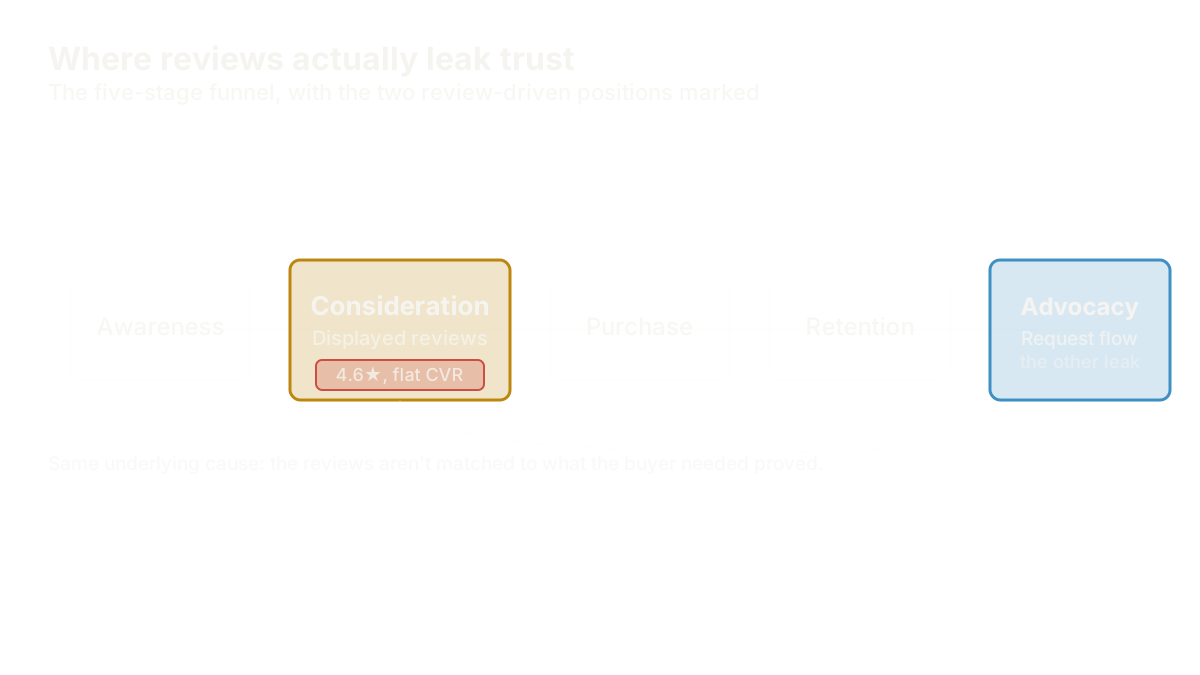
Amazon Reviews Not Converting? Start With the IDEA Pillar That's Failing
Reviews aren't one undifferentiated trust signal. They do four different jobs, and a listing can ace three of them while quietly failing the fourth. The IDEA framework names the four: Insight-Driven (do you understand my situation better than the other listings), Distinctive (is there a real reason to pick you over the near-identical competitor), Empathetic (do you get what I'm actually worried about), Authentic (does this feel like a real brand, not a dropship shell). A star average of 4.6 tells a shopper "this product mostly works." It says nothing about which of those four questions your specific reviews are answering, and a shopper who scrolls your reviews looking for reassurance on one particular pillar and finds none of it will bounce, no matter how many five-star ratings surround the gap.
run_trust_gap exists for exactly this. It scores each of the four pillars against the evidence on your actual listing, not against a generic checklist, and names the weakest one. Most founders assume the fix, if there is one, is Distinctive: "our reviews don't make us sound different enough." In practice the more common finding is a quiet Empathetic gap: the reviews prove the product functions, but none of them speak to the specific fear or frustration that got the buyer to the listing in the first place. That's a subtler failure than "we need better reviews." It's "we have the right reviews and none of them are being shown to the person who needed to see them."
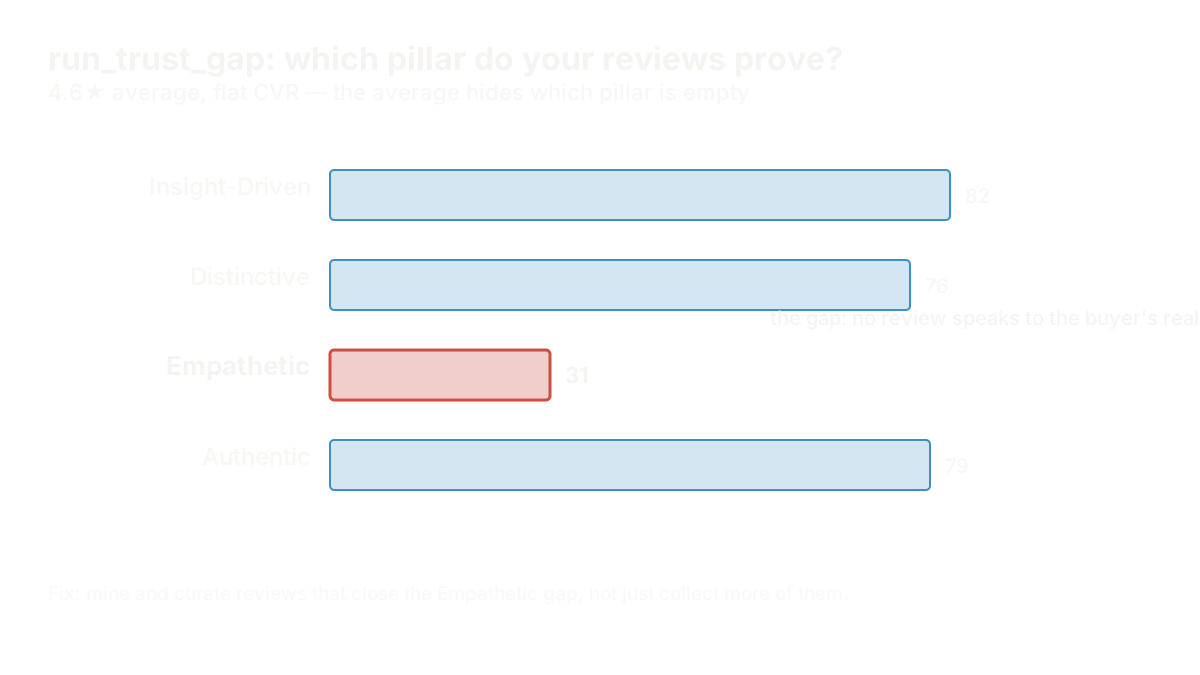
If your star rating and your conversion rate have already decoupled and you want the pattern from a real diagnosis, a high rating that isn't lifting conversion walks through exactly that scorecard read. The fix, once you know the weak pillar, usually isn't collecting more reviews. It's rereading the ones you already have with a different question in mind, which is the next section.
Mine the 4-Star Reviews, Not Just the 1-Stars
Most founders triage reviews by star count, and most triage habits point the wrong direction: check the 1-stars for fires, skim the 5-stars for testimonial material, and never really read the middle. That middle is where the fixable objections live. A 5-star review that says "love it, arrived fast" tells you almost nothing actionable. A 4-star review that says "works great, wish it were a bit quieter" is a customer handing you the exact sentence your next bullet point needs, and it's sitting in the pile founders scroll past on the way to the 1-stars.
ingest_evidence parses the full review set as evidence rather than triaging by star rating the way a founder skimming a dashboard does. It surfaces the objection pattern wherever it's actually clustering, which is frequently not where the anxious founder is looking. This matters for a second reason too: reviews often already contain the psychological lever your listing hasn't pulled yet. A recurring line about how fast a customer went from "considering" to "bought two more" is evidence of momentum as a live decision trigger, sitting unused in your own review section.
Three supporting diagnoses go deeper here. Reading 4-star reviews for the objection hiding in them is the starting discipline. Generic five-star reviews that say nothing useful covers the opposite failure: praise with zero specificity, which is often a review-request problem more than a product problem (more on that below). And review highlights that use the wrong vocabulary covers a subtler trap: your featured snippets may be accurate and still fail, because they're phrased in your brand's language instead of the customer's own words. If you suspect a review is quietly proving a trigger you haven't named on the listing, reviews that reveal an unused momentum trigger shows what that looks like in practice.
Curate Featured Reviews Against the Avatar, Not a Guess
Amazon and most storefront tools let you pin or highlight certain reviews. Founders almost always make that pick on instinct: the most articulate review, the one that flatters the product most, the one a team member happened to notice. None of those criteria have anything to do with which review will move the specific buyer standing on your listing right now.
The right selection criteria come from the avatar, not the founder's taste. build_avatar_stage builds a forensic customer profile in four layers: S1 vocabulary (the exact words the customer uses), S2 job map (what they're actually trying to accomplish), S3 triggers (the psychological lever that gets them to buy), S4 objections (what's stopping them). A featured review should be selected because it happens to hit the avatar's S3 trigger or resolve an S4 objection in the customer's own S1 language, not because it reads well to the person running the listing.
This is where the Empathetic gap from the first section usually gets closed. If your trust-gap read points at Empathetic and your review mining surfaced the right objection, curating the featured reviews around that specific objection, in the customer's own words, is a highly targeted fix rather than a cosmetic reshuffle. Featured reviews that miss the buyer's real trigger covers this failure mode end to end, including what an avatar-matched pick actually looks like next to a founder's first guess.
Fix the Review Request Flow Itself
Everything above assumes you have reviews worth mining and curating. Plenty of brands don't, not because customers are unhappy, but because the request flow that generates reviews is broken in one of three specific ways: timing, question, or coverage.
Timing: don't ask before the product has proved itself
A request sent the day a package arrives asks a customer to review an unboxing experience, not a result. For a consumable, a skincare product, or anything with a break-in period, that's asking for a review before there's anything true to say yet, which is exactly how a brand ends up with a pile of generic five-star reviews: accurate, enthusiastic, and useless, because the customer genuinely hadn't formed an opinion beyond "packaging was nice" when the request landed. Asking for reviews before the product has proved itself covers how to time the ask against the actual use cycle instead of the shipping cycle.
The question you ask shapes the review you get
"How was your experience?" is a request template, not a question, and it produces exactly the review you'd expect from a template: pleasant, vague, and unhelpful to the next shopper deciding whether to buy. A request that asks something closer to the customer's actual job (what changed, what you were worried about before you bought, whether it delivered on that) tends to produce a review that resolves another buyer's specific hesitation, because it asked the customer to write about the hesitation instead of the delivery experience. A review-request email asking the wrong question shows the difference between a generic prompt and one built around a real decision trigger.
Funnel coverage: the weakest link usually isn't the product
Review requests don't live in one email. They live across a welcome series, a packaging insert, sometimes a follow-up at the point a consumable is due for reorder. It's common for one of those touchpoints to carry the entire weight of review generation while the others say nothing about it at all, which means the flow's overall performance rests on a single link nobody's stress-tested. A review-request flow with real coverage gaps walks through auditing the whole flow rather than one email in isolation, and the weakest link turning out to be the request flow, not the product is the same audit applied to a brand that assumed its flat review growth was a quality problem when it was a coverage problem.
Measure Whether the Rewrite Actually Moved Anything
A rewritten request email or a re-curated review section can feel like it worked within a week: more replies, a couple of enthusiastic new reviews, a founder's gut sense that things are better. Feelings aren't evidence. compute_trust_gap_lift gives you a before-and-after delta on the same pillar run_trust_gap flagged as weak, so you can tell whether the specific gap actually closed rather than whether the review count went up in a way that feels good but doesn't move the pillar that mattered.
This matters because review fixes decay differently than image or copy fixes. A featured-review reshuffle can lift conversion for a few weeks and then flatten again if the underlying request flow keeps producing the same generic reviews it always did, quietly diluting the curated ones back into noise. Measuring the trust-gap delta, not just star count or reply rate, catches that decay before it erases the fix. Measuring whether a review-request rewrite actually moved anything works through a full before-and-after read, including what to do when the number doesn't move the way the founder expected.
FAQ
Why do I have great reviews but low conversion on Amazon?
A strong star rating measures whether the product works, not whether your specific reviews answer the question your specific buyer is asking on this listing. Run a trust-gap read across the four IDEA pillars to find which one your displayed reviews fail to prove, then check whether your featured reviews and request flow are built around your real avatar or a founder's guess.
Should I read my 1-star or 4-star reviews first?
Read both, but don't stop at 1-star. One-star reviews flag reputational fires; 4-star reviews usually contain the specific, fixable caveat sitting between "kept it" and "loved it." That caveat is often the single most actionable line in your entire review set, and it rarely shows up as anger.
How do I pick which reviews to feature on my listing?
Match the featured review to your avatar's actual decision trigger and objection, in the customer's own vocabulary, not to whichever review reads best to you. A forensic avatar build surfaces the trigger and the language; use that as the selection filter instead of instinct.
When should I send an Amazon review request?
After the product has had enough time to prove itself for its category, not on delivery day. Sending too early produces accurate but generic reviews about unboxing rather than results, which is one of the most common causes of a review pile that looks fine and converts nothing.
How do I know if my review-request rewrite worked?
Track the trust-gap delta on the specific pillar you targeted, not just review count or star average. A rewrite can produce more reviews without closing the gap that was actually costing you conversion, and the only way to catch that is measuring the pillar directly, before and after.
The bottom line
If your reviews look healthy on paper and your conversion rate still isn't moving, the fix is rarely "get more reviews." It's diagnosing which trust pillar the displayed reviews fail to prove, mining the objections sitting in your 4-star pile, curating around your real avatar instead of a guess, and fixing the request flow that's generating the reviews in the first place. Run the free trust gap diagnostic to see where amazon reviews not converting traces back to on your own listing, then work the sections above in order.
Find the Trust Gap costing you sales
The free IDEA Brand Coach diagnostic reads your listing and your reviews, then shows you where your read of your brand and your customers' differ. 4 questions while it works. No account needed for your score; create a free one to keep the full read and your design brief.
Run the free diagnostic →